
How to Search Criminal Dockets
Effingham County's main public index is the Effingham County CM Web Search. It covers State and Superior Court cases. Pick ST for State Court or SU for Superior Court. The portal supports Party, Associated Party, and Case Number searches. But it leaves out Magistrate, Probate, Juvenile, municipal, and federal records.
Search with the narrowest facts on an official notice. An exact case number beats anything else. A name search may require spelling variants plus a filing-date range. If the online docket fails you, call the Clerk at 912-754-2118. Or try the criminal and civil counter at 912-754-2146. The office sits at 700 N Pine Street, Suite 110, Springfield. Hours differ across county pages, so confirm them before any counter visit.
- Select State Court or Superior Court.
- Choose Party, Associated Party, or Case Number.
- Set the case type to CRIMINAL and use dates only when known.
- Open a likely result and review its Proceedings tab.
- Ask the Clerk for an image or certified copy when the index is not enough.
The official criminal Party Search screen displays the exact fields a local name lookup uses.
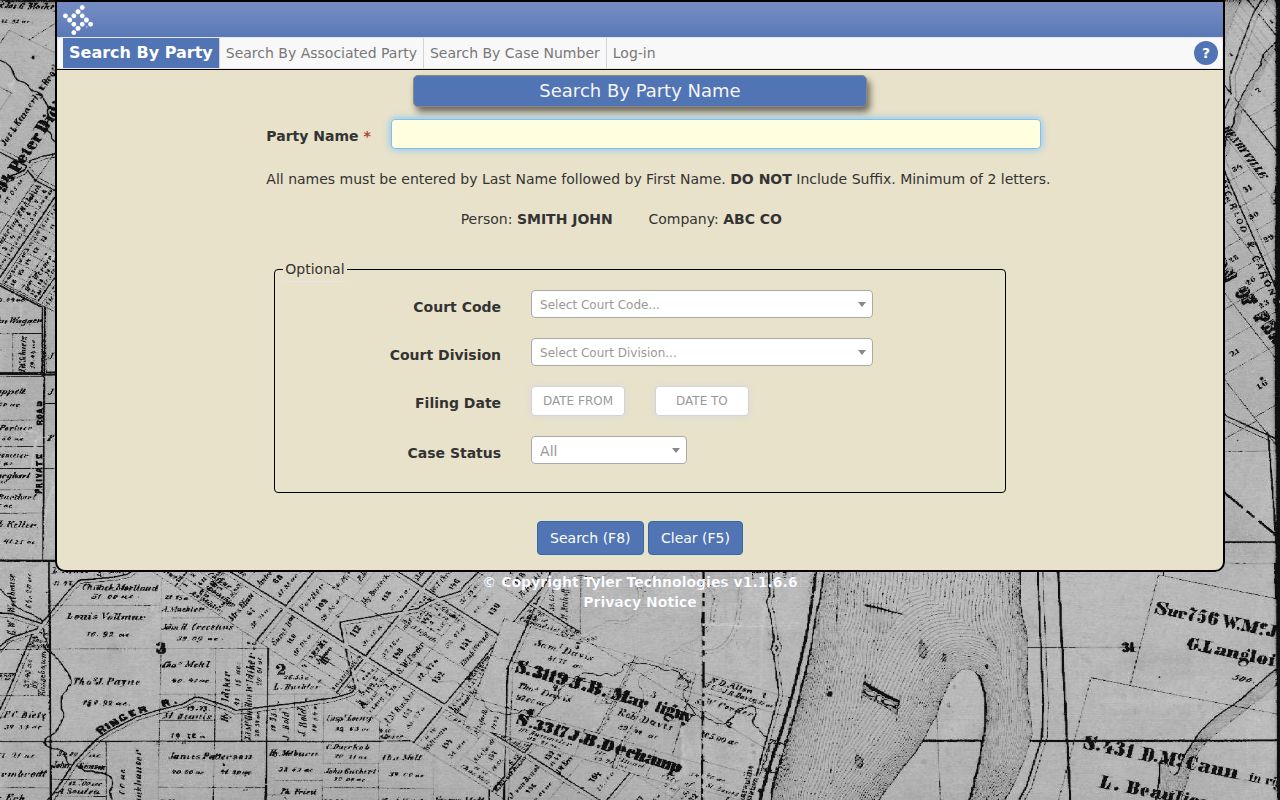
Court choice, dates, criminal case type, and status all shape the query. Check those limits before assuming no case exists.
Effingham County Criminal Searches
Party Search and Associated Party Search answer different questions. The first finds a person or organization indexed as a party; the second can locate an attorney, prosecutor, or other indexed connection. Neither shows every role, filing, or image. The county's Associated Party interface opens that second route.
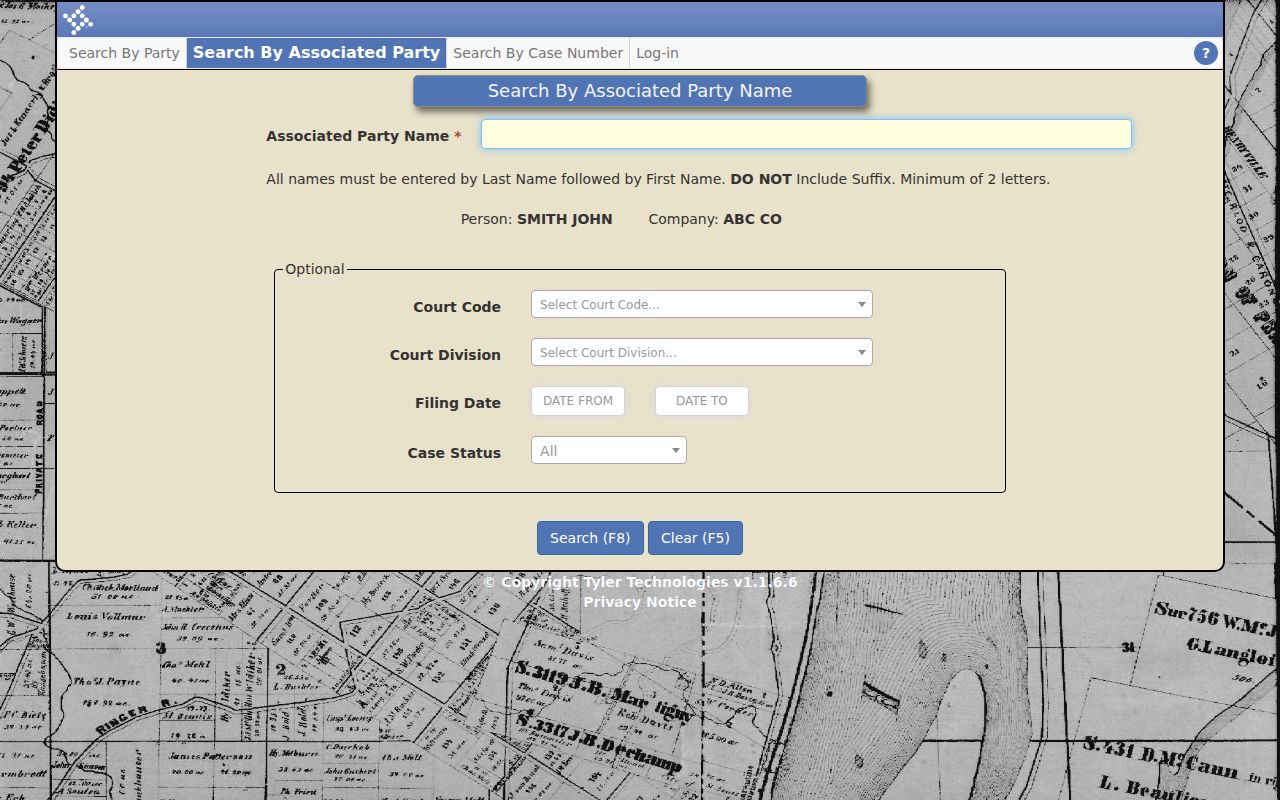
Use this form when a notice names counsel but the party spelling is unclear. It still searches only the State and Superior index.
No result does not mean no case. Recheck ST and SU, remove a date limit, try a spelling variant, then ask the court that may hold the matter.
What a Criminal Docket Shows
The blank portal and its user guide set a limited field model. They show how a case is indexed. They do not expose a universal charge, bond, judge, sentence, or financial field. So treat any docket result as an index to proceedings. It is not the full criminal file.
| Court code | ST for State Court or SU for Superior Court. |
|---|---|
| Case number | Court, dynamic division, filing year, and a zero-padded six-digit sequence. |
| Case type | CRIMINAL identifies the selected case category. |
| Status | ACTIVE or INACTIVE, which must not be converted into a legal conclusion. |
| Proceedings | Dated events and possible document-image indicators in the case history. |
| Filing date | The file date or search range, not necessarily the next hearing date. |
Turn to the actual docket entry or court record for a charge, plea, disposition, or sentence. An inactive label alone proves nothing about dismissal, conviction, expungement, payment, or completion.
Effingham County Criminal Images
The public index and the filed image are two different access layers. The Clerk's user guide describes a workflow for available document images. It involves an account, approval, a Proceedings tab, and a cart. The published pages list no current image fee. Before paying anything, ask the Clerk some questions. Ask what can be viewed and what must be ordered. Ask whether certification is needed too. A docket entry can name the filing to request. But it will not reproduce every fact inside that document.
Effingham County Criminal Courts
Jurisdiction is the first fork in any Effingham County docket search. Effingham County Superior Court is part of the Ogeechee Judicial Circuit. It holds broad criminal power and conducts felony trials. Effingham County State Court handles county misdemeanors, DUI matters, and traffic offenses. Magistrate Court performs warrant and bail functions. However, no Magistrate code appears in CM Web Search.
| Court | Criminal role | Starting route |
|---|---|---|
| Superior Court | Felony trials and broad jurisdiction | CM Web Search SU or Clerk |
| State Court | Misdemeanor, DUI, county traffic | CM Web Search ST or State Court |
| Magistrate Court | Warrants and bail functions | Magistrate office, 912-754-2124 |
| Municipal Court | City traffic and ordinances | Rincon, Springfield, or Guyton clerk |
| Juvenile Court | Delinquency and juvenile matters | Restricted Juvenile Clerk route |
The Effingham State Court site names the local misdemeanor and traffic court and lists its administrative contacts.
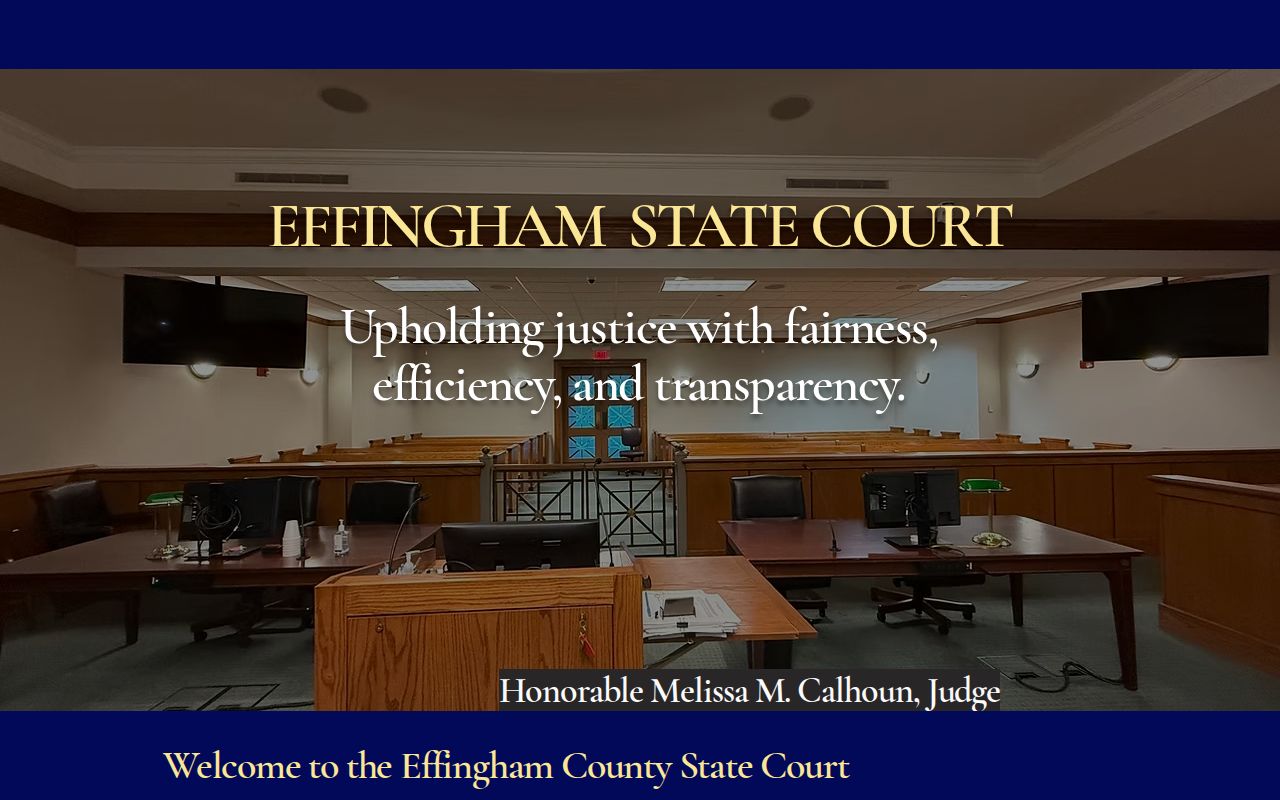
That court page helps with office and procedure questions. For an individual State Court case, CM Web Search stays the public index.
Stages on a Criminal Docket
A criminal docket grows entry by entry as the clerk records events. Sequence varies by charge and court. Some cases end before trial. Even so, the record moves through recognizable phases that help place a dated entry in context.
Docket flow: Filing › Arraignment › Pretrial › Plea or Trial › Disposition › Sentencing
- Arraignment
- A proceeding where the charge and plea process are addressed.
- Continuance
- A change to a setting that requires court approval.
- Disposition
- The recorded outcome. A status label is not a substitute for it.
- Proceedings
- The portal area for dated case activity and possible images.
For a court date, rely on the citation or an official setting notice. The State Court criminal assistant handles scheduling at 912-754-2117. Calling does not grant a request by itself.
Effingham County Criminal Dates
The State Court FAQ points to the citation for a traffic hearing date. Lost or unclear? Call the Clerk at 912-754-2118. A missed setting demands prompt contact. A continuance or cancellation requires the judge's prior approval, so a phone request never changes the docket on its own.
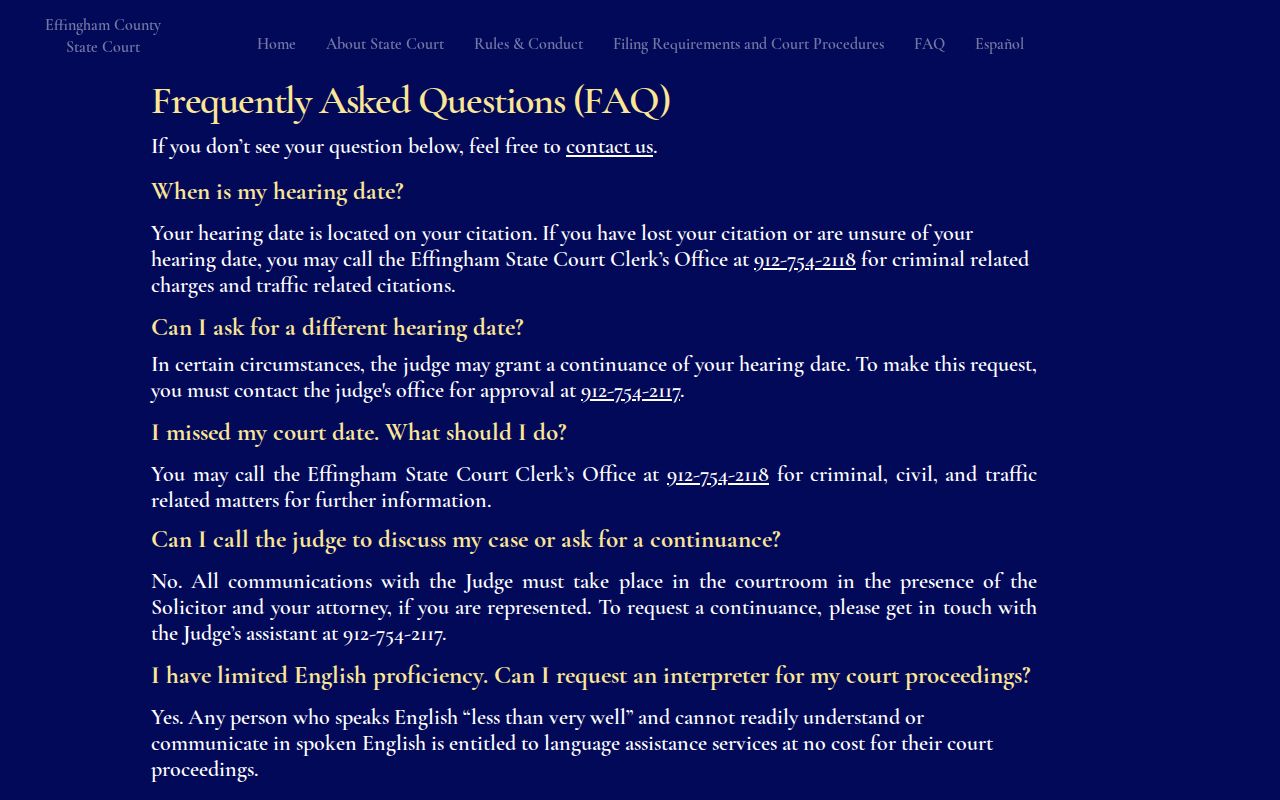
This source keeps scheduling questions separate from the docket search itself. The Effingham County court calendar overview walks through the full hierarchy of date sources.
Keep court name, room, date, time, and source together. A filing date is not a hearing date. A monthly court schedule does not prove one case is set that day. When two sources conflict, check the citation, the newest notice, and the assigned court. Only then rely on either display.
Which Court Holds Criminal Dockets
Start with the offense level and the issuing court shown on your notice. Felonies belong to Superior Court. County misdemeanors, DUI charges, and county traffic cases go to State Court. A city citation may stay with that municipal court. Keep one caution in mind: a warrant step in Magistrate Court does not by itself establish that a Superior felony docket has been filed.
Watch the case number prefixes, ST and SU. If the case does not appear under either, call the likely court. Magistrate Court sits at 700 N Pine Street, Suite 250, and answers at 912-754-2124. Juvenile Court, reached at 912-759-1400, handles confidential categories. Federal criminal cases are separate, filed in the U.S. District Court for the Southern District of Georgia and searched through PACER.
This split causes a common search error. The county portal covers two vital courts. It is not one index for all criminal proceedings in Effingham County. An empty result can mean the wrong court. It can also mean a narrow filter, a restricted record, or a matter that never reached the searched court.
Effingham County Criminal Workload
Georgia's 2025 Superior Court workload assessment puts a three-year average of 2,640 felony defendants on the Ogeechee Judicial Circuit. That number is circuit-wide context. It is not an Effingham County case count. Use it to understand why court and division filters matter in a docket search, not to predict how long one case will take.
Effingham County Program Dockets
The Ogeechee Circuit Mental Health and Drug Court serves the whole circuit. It works as a problem-solving program. The program is public. Its description covers history, eligibility, exclusions, and structure. None of that describes a participant. It does not prove that a given person entered the program. Nor does it show completion or any specific docket status.
For the official program context, see the Clerk's Ogeechee Mental Health and Drug Court page. It lays the program out. That page shows what the court itself publishes about the program.
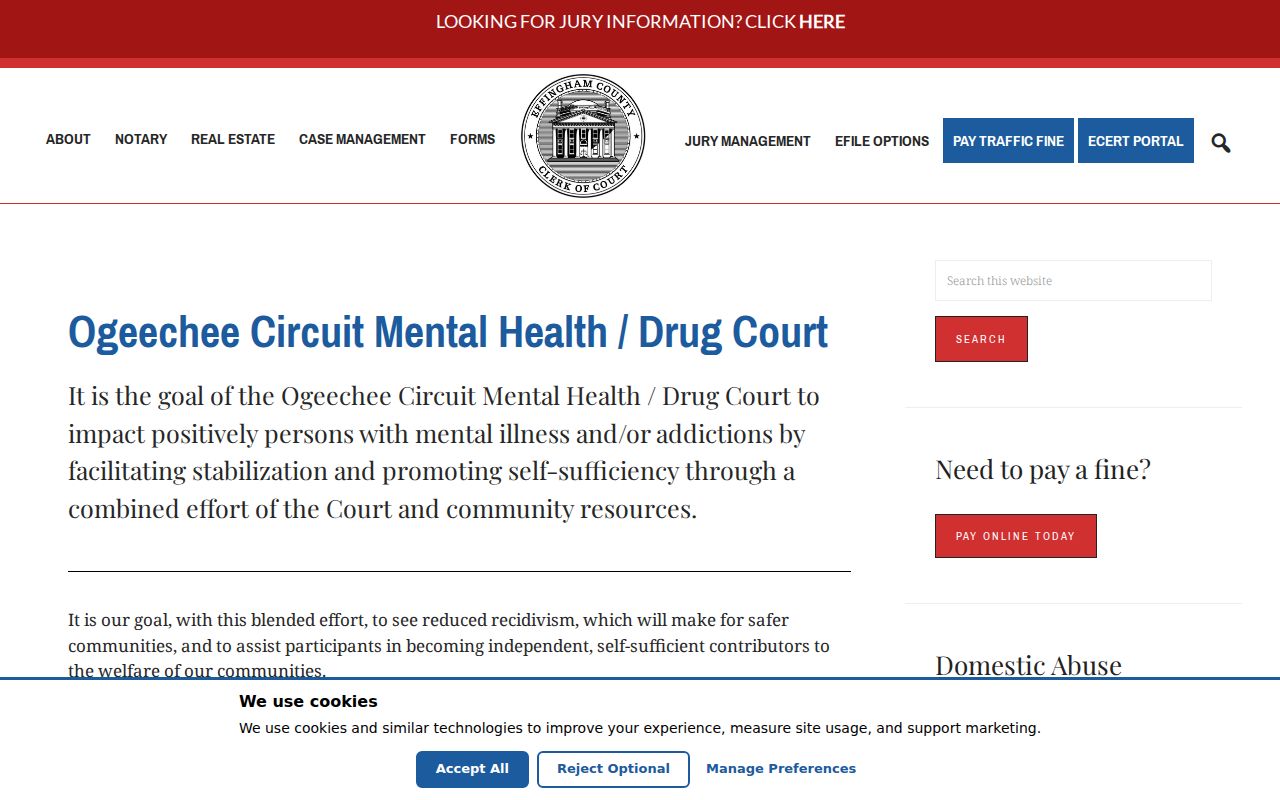
Case proof needs the docket and Clerk confirmation. Program pages cannot replace a filed order or a proceeding entry. A specialty court can be described in public while its participant files follow their own access rules. That gap is exactly why the distinction matters.
Effingham County Criminal Status
The portal offers ACTIVE and INACTIVE status filters, with no published list of disposition codes. Active is a search category. It does not prove that a hearing is pending. Inactive is also just a category. By itself it does not mean dismissed, closed, sealed, expunged, paid, or completed.
- Filing date
- The date used to limit a portal search. It may differ from an arrest date, citation date, or hearing date.
- Docket entry
- A dated filing or event recorded in the case history.
- Proposed order
- A document offered for a judge's review, not an entered ruling.
- Final order
- A court ruling whose actual terms must be read rather than guessed from status.
Read the newest relevant proceeding and any linked order before describing an outcome. A label is not a ruling. When an image will not open, identify the entry by date and title and ask the Clerk for the public document. That keeps index and order distinct.
Effingham County Criminal Privacy
Public access does not mean republishing private details. Georgia's rules shield account identifiers, portions of identification numbers, a minor's identity, and other covered data. Keep your notes broad. Never copy a home address, birth information, financial number, or protected juvenile fact from an image.
Public Access and Sealed Criminal Dockets
Georgia starts from open court access. Statutes, rules, and court orders can still limit a file or specific material. Uniform Superior Court Rule 21 supplies the framework for limiting access and redacting protected identifiers. O.C.G.A. §9-11-7.1 addresses personal identifiers in covered filings. Juvenile matters are confidential. Never infer sealed or redacted content from an empty portal result.
Key access rules
Uniform Superior Court Rule 21 sets the public-access and sealing framework.
O.C.G.A. §9-11-7.1 materials describe protected identifier redaction.
Georgia Rule 616-1-2 governs electronic filing and preserves lawful access limits.
CM Web Search may show an index. It may also demand an approved account and the Clerk's cart workflow for images. So ask the custodian directly about a withheld item. Request a redacted copy or public index entry. Ask which rule, statute, or order controls. Effingham County GovQA is not the route for court filings. The county sends those records to the Clerk.
In-person review at the Clerk's office is the practical fallback. Public-terminal availability is not guaranteed. Mail, email, fax, and drop-box are not established as universal record-request channels here. Confirm an office-specific method before sending private data or payment.